
Quick answer: A seller in St. Clair County, Illinois usually pays the state and county transfer taxes, a property tax credit to the buyer (Illinois taxes are paid a year behind), the owner’s title insurance policy by custom, their own attorney, the mortgage payoff, final utility bills, and whatever brokerage compensation their listing agreement sets.
Most sellers know the sale price. Fewer know the list of things that come out of it before the check is cut. None of it is mysterious, but a couple of the items surprise people every time, especially the property tax credit.
Here is each seller cost in a typical St. Clair County sale, what it is based on, and where the number comes from. Your contract controls who pays what, and a real estate attorney should review your final figures before closing.
1. Illinois and St. Clair County transfer taxes
Illinois charges a tax on the privilege of transferring title to real estate. The rate is set in the Real Estate Transfer Tax Law (35 ILCS 200/31-10):
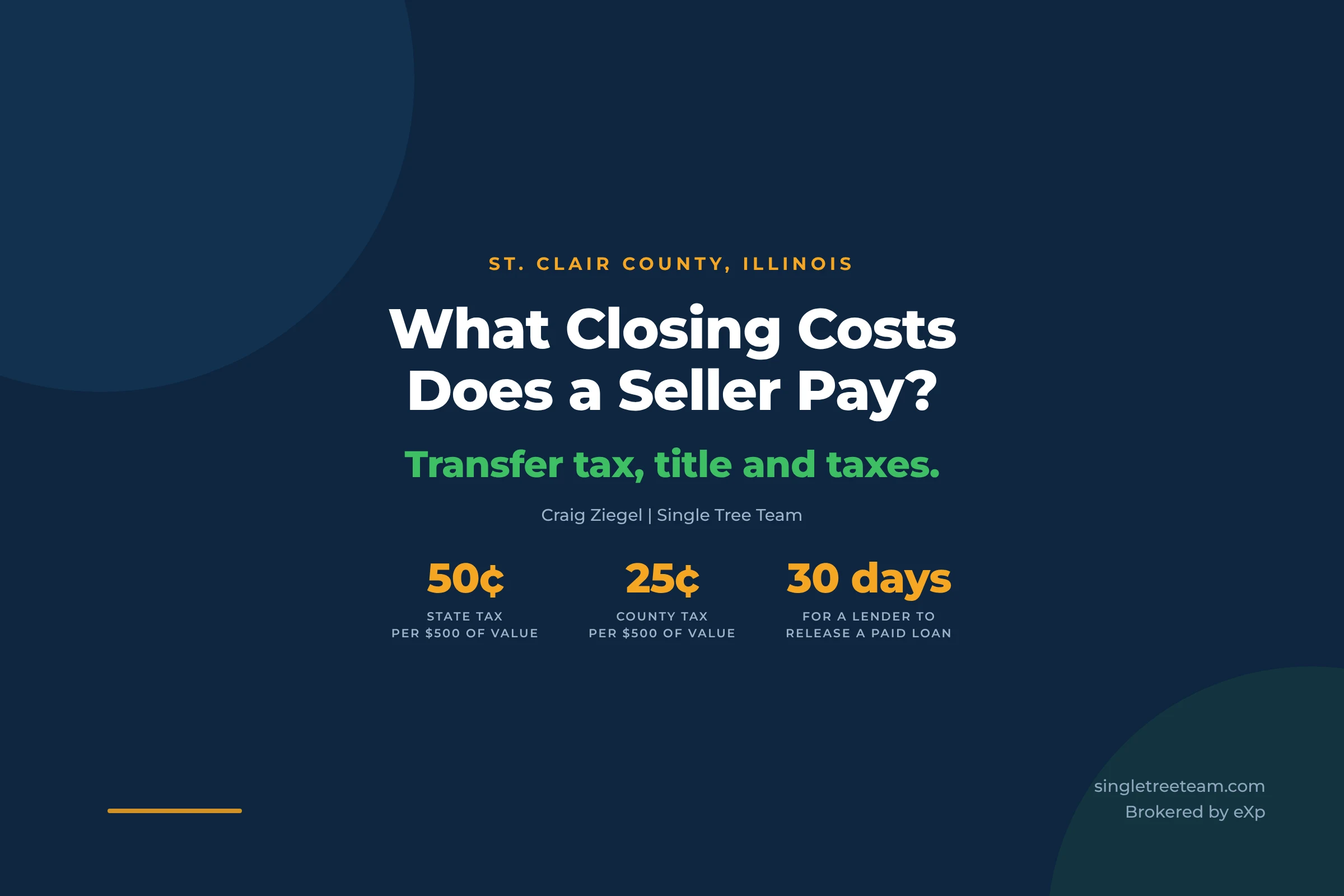
- State of Illinois: 50 cents for each $500 of value, or fraction of $500.
- County: Illinois counties may add 25 cents for each $500 of value under the Counties Code (55 ILCS 5/5-1031). The county recorder collects it before the deed is recorded, and the Illinois REALTORS statewide listing shows the county tax in all Illinois counties.
Put in plain numbers, that works out to $1.00 of state tax and $0.50 of county tax for every $1,000 of sale price. For each $100,000 of price, that is $100 to the state and $50 to the county. The transfer is also reported on the state’s PTAX-203 declaration, which is signed by at least one seller and one buyer (or their attorneys or agents).
The statute does not say which side pays. By custom in Illinois it is the seller, and a statewide transfer tax listing from Illinois REALTORS describes the state and county taxes as “Either; Seller customary.” Your contract is what actually decides it.
Is there a Belleville transfer tax?
Illinois lets home rule municipalities add their own transfer tax, and some Illinois towns do. We did not find one for Belleville. The “Specific Taxes” section of Belleville’s published city code (current through an ordinance passed March 2026) lists utility, sales, hotel and other taxes, but no real estate transfer tax. That is not the same as a guarantee, so ask your title company or attorney to confirm the stamps required for your address, especially if you are selling in another St. Clair County town.

2. The property tax credit to the buyer
This is the item that confuses sellers most.
Illinois property taxes are paid in arrears. The Illinois Department of Revenue puts it this way: the tax year reflects the value as of January 1, and the actual tax bills are paid in the year following the tax year. Taxes on a 2025 assessment are paid in 2026.
So when you sell, you have lived in the house for part of a tax year that nobody has been billed for yet. The buyer will get that bill next year. To make it fair, you give the buyer a credit at closing for the taxes that built up while you owned the home. If a bill for a prior year is still unpaid, it gets paid out of your proceeds too.
Nothing extra is being charged here. You are paying your own taxes for the time you owned the house, just at closing instead of on next year’s bill. How the credit is estimated, since the future bill is not known yet, is set in your contract, so read that paragraph with your attorney. If you want to understand why the bills here are what they are, see our post on why St. Clair County property taxes are so high.

3. Owner’s title insurance policy
Title insurance protects the buyer against covered problems with the title that existed before they bought, like an old lien or a recording error. There are two kinds: an owner’s policy for the buyer, and a separate lender’s policy if the buyer is getting a loan.
In Illinois, the seller customarily pays for the owner’s policy. That is custom, not a law, and it can be negotiated in the contract. One useful detail from the Illinois Department of Financial and Professional Regulation: the party paying for title insurance has the right to choose the title insurance agent and company. Premiums vary by company and price, so ask for a quote.
4. Your real estate attorney
The Illinois State Bar Association recommends consulting an experienced real estate attorney before you sign anything. Their guide lists what a seller’s attorney typically handles: getting your loan payoff statement, helping choose the title company, prorating real estate taxes, preparing the deed and closing figures, and attending closing with you.
Fees vary by attorney and by how complicated the sale is. Ask about the fee arrangement up front, as the ISBA suggests, so it is not a surprise on the settlement statement.
5. Mortgage payoff and release
Your mortgage is paid off from the sale proceeds at closing. Two things to know:
- The payoff is not your statement balance. A payoff statement from your lender shows the exact amount good through a specific date, including interest. The closer uses that figure, not the balance on your last bill.
- Every lien comes off. A home equity loan or line of credit, and any recorded judgment or lien, must be paid or resolved for the buyer to get clear title.
After payoff, the lender has to release the mortgage. Under the Illinois Mortgage Act (765 ILCS 905/4), a lender that knows the loan is paid and does not provide the release within 30 days can be liable to the owner for a statutory penalty plus attorney’s fees. If a release never shows up in the county records, tell your attorney or title company.

6. Final water, sewer and utility bills
Schedule final meter readings for the day of closing or possession and pay the final bills, or have them settled at closing. In Belleville this matters for more than tidiness. The City of Belleville says all sewer bills for a property must be paid and up to date to schedule the housing inspection or receive an occupancy permit.
Belleville’s occupancy inspection
Belleville requires a residential occupancy permit, based on a city inspection, before a home can be legally occupied. Violations found must be corrected before occupancy. Repairs it turns up can add cost, and the city recommends scheduling the inspection as soon as you decide to sell. Who pays for any corrections is a contract question.
7. Condo or HOA items
If you are selling a condominium, Section 22.1 of the Illinois Condominium Property Act requires you to obtain from the association and make available to the buyer, on request, items like the declaration and bylaws, a statement of unpaid assessments, anticipated capital expenditures, reserves and insurance. The association may charge the seller a fee for providing them, capped by the statute. Unpaid assessments are settled at closing. Homeowners associations outside condos vary, so check your documents.
8. Brokerage compensation
If you list with a brokerage, you pay whatever you agreed to in your listing agreement. It is negotiable, and it is spelled out in writing before your house goes on the market, so there is nothing to guess at here.
9. Anything you agreed to in the contract
Credits for repairs after the inspection, a home warranty, closing cost help for the buyer, or repairs required by the city all show up here. These are the costs you have the most control over, because each one is a negotiation.
The honest take
Transfer taxes and title are predictable. The property tax credit is large but it is your own tax bill, not a fee. The costs that actually vary are repairs, credits and anything the city inspection turns up. Ask your attorney for an estimated seller settlement statement before you accept an offer, not the week of closing. The rest of the selling process is in our St. Clair County home sellers guide.
Frequently asked questions
Does the seller pay transfer tax in Illinois?
By custom, yes. Illinois charges 50 cents per $500 of value and counties may add 25 cents per $500. The statute does not name a payer, so the sales contract decides, but the seller customarily pays the state and county transfer taxes.
Does Belleville, Illinois have a city transfer tax?
We did not find one. The Specific Taxes section of Belleville’s published city code, current through March 2026, lists no real estate transfer tax. Belleville does require a residential occupancy permit and city inspection before a home is occupied. Confirm the required stamps for your address with your title company or attorney.
Why does the seller give the buyer a property tax credit at closing?
Illinois property taxes are paid in arrears, in the year after the tax year. The buyer will receive the bill covering months you owned the home, so you credit them for those taxes at closing. The contract sets how the credit is estimated.
Who pays for title insurance in Illinois?
The seller customarily pays for the owner’s title insurance policy. It is custom rather than law and can be negotiated. Under Illinois regulator guidance, the party paying for title insurance chooses the title company.
Want to see your own numbers?
Every cost on this list starts with one number: what your house will sell for. Get a free home value estimate, or call and we will sketch out a seller net sheet with you, so the closing statement looks the way you expected.
Craig Ziegel, Single Tree Team, eXp Realty. Serving Belleville, O’Fallon, Shiloh, Swansea, Mascoutah, Millstadt, Freeburg and the rest of St. Clair County.