
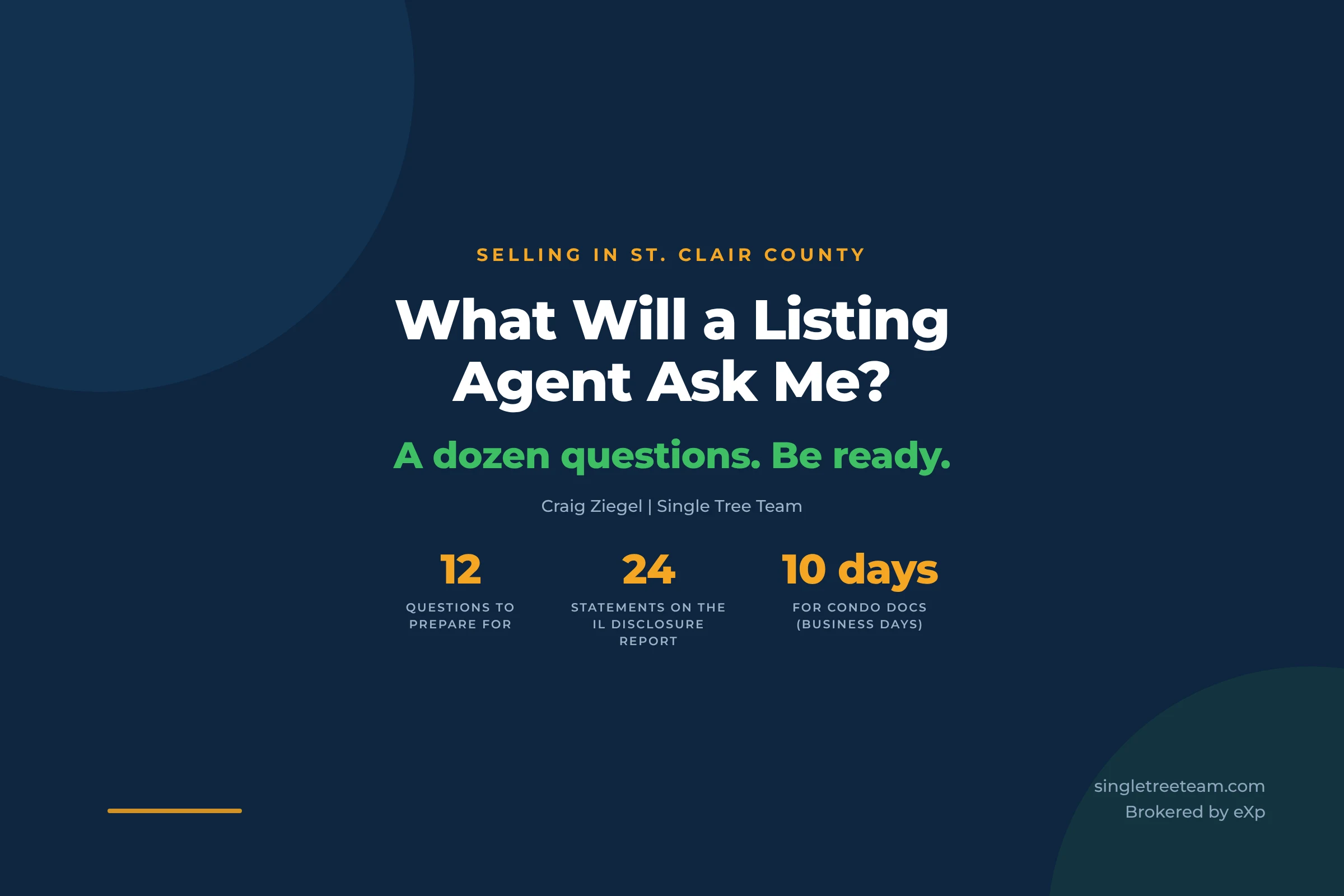
Quick answer: Expect questions about why and when you are moving, what you owe on the house, what you have updated and when, anything you know is wrong, HOA rules, permits, utility costs, what stays, showing limits, pets, who lives there, and what price you are hoping for. Having the answers ready makes the appointment faster and your pricing more accurate.
A listing appointment is not a test, but it goes better as an open-book one. The agent is learning enough about your house and situation to price it well and avoid surprises later.
Here are the twelve questions I ask sellers around Belleville and St. Clair County, why each one matters, and a checklist at the end you can print and fill out before we sit down.
1. Why are you moving, and when do you need to be out?
This is not nosiness. Your reason and your deadline drive almost every other decision: how aggressively to price, whether to do repairs first, how flexible to be on closing dates, and whether you need to buy your next place before this one sells.
A job transfer with a start date, orders out of Scott Air Force Base, a growing family, a parent moving in with you. Each one points to a different plan. If you are also buying, our post on whether to sell before you buy is worth reading first. If you are wondering about the calendar, homes that sold in St. Clair County took a median of 29 days in July and 39 in December and January, per our look at the hardest months to sell.
2. What do you owe on the house?
Your agent needs a rough payoff to know what you will walk away with. Bring your most recent mortgage statement, and mention any second mortgage, home equity line of credit, or lien you know about. Those all have to be paid off or resolved at closing.
While you are gathering paperwork, the Illinois State Bar Association’s guide for sellers suggests having your title policy, deed, survey and current mortgage statement (with the loan number and customer service number) ready for your attorney too. Same pile, two uses.

3. Who is on the title?
Everyone who owns the house has to sign. If a former spouse, a sibling, an estate or a trust is on the deed, say so at the start. Those situations are completely workable, but they add steps and sometimes an attorney, and it is far better to know on day one than the week of closing.
4. What have you updated, and when?
Buyers and their inspectors care about the expensive parts of a house. Your agent will ask about the age of:
- Roof
- Furnace and air conditioner
- Water heater
- Windows
- Electrical panel and plumbing updates
- Kitchen and bathroom remodels, flooring, paint
Approximate years are fine. Receipts, warranties and contractor names are better. A roof replaced in a specific year, with an invoice, is a selling point. “Pretty new, I think” is a question mark in a buyer’s mind.
5. Is there anything wrong with the house that you know about?
This is the one people hesitate on, and it is the one that matters most. Illinois sellers of most homes have to complete the Residential Real Property Disclosure Report, which asks 24 yes, no or not applicable questions about things like basement leaks, foundation, roof, electrical, plumbing, heating and cooling, radon, termites and more. Your answers are based on what you actually know. You are not required to investigate.
Also expect to be asked whether you have ever tested for radon, and whether the house was built before 1978, which brings a federal lead paint disclosure. Under Illinois license law, a listing agent must disclose known latent material defects to buyers, so there is no “just between us” here. It is much easier to price and explain a known problem up front than to renegotiate after an inspection. If you are unsure how to answer a disclosure question, ask a real estate attorney.
6. Is there an HOA or condo association?
Your agent will want the dues, what they cover, any special assessments, and the rules (rentals, fences, sheds, parking). If you are selling a condominium, Section 22.1 of the Condominium Property Act requires the seller to obtain certain documents from the association, like the declaration, bylaws, a statement of unpaid assessments, reserves and insurance, and make them available to the buyer on request. The association has 10 business days to furnish them once asked in writing, so it helps to request them early.
7. Was work done with permits?
Finished basements, additions, decks, electrical work and converted garages all raise the permit question. If you have the permits, bring them. If you are not sure, say that. Your agent is not trying to catch you out, but it affects how the space is described and what a buyer’s inspector may flag.
In Belleville there is a related step. The City of Belleville requires a housing inspection and residential occupancy permit before a home can be legally occupied, recommends sellers schedule the inspection as soon as they decide to sell, and says sewer bills must be current to schedule it. Outside Belleville, ask your city or village what applies.

8. What do utilities and taxes cost?
Buyers ask what it costs to live in the house, so your agent will too. Pull up the last 12 months of electric, gas, water, sewer and trash bills if you can, and note your providers. Bring your most recent property tax bill as well. If taxes are a sore subject, our post on why St. Clair County property taxes are so high explains the bill.
9. What stays and what goes?
Appliances, the washer and dryer, window treatments, mounted TVs and brackets, the shed, the playset, the chandelier your grandmother gave you. Decide now. Anything you plan to take that a buyer might assume stays should be removed before photos or clearly excluded in writing.
10. When can buyers see it?
Your agent will ask about work schedules, night shifts, how much notice you need, and times that are off limits. The more open the showing window, the more buyers can see the house, but it has to be livable for you. Tell your agent honestly what you can manage.
11. Pets, and who lives there?
Pets affect showings (crate them, take them along, or leave a note for the buyer’s agent). Occupancy matters too. An owner-occupied house, a vacant one and a tenant-occupied one each need a different plan. If there is a tenant, bring the lease, because its terms affect when a buyer can get in and when they can take possession. Ask an attorney about tenant rights before you promise a buyer a move-in date.
12. What price are you hoping for, and what do you need to net?
Say the number out loud, even if it came from a neighbor’s sale or an online estimate. A good agent will show you recent comparable sales and where your house fits. What you need to walk away with, after payoff and closing costs, matters just as much. Our post on how to price your house properly explains how that number gets built.
Your listing appointment checklist
Print this, fill in what you can, and have it on the table when your agent arrives.

Your move
- ☐ Reason for moving: ____________
- ☐ Date I need to be out: ____________
- ☐ Buying another home? Yes / No / Not sure
- ☐ Everyone on the title, and are they all on board?
Money
- ☐ Latest mortgage statement (loan number and lender phone)
- ☐ Second mortgage, home equity line or liens: ____________
- ☐ Most recent property tax bill
- ☐ Price I am hoping for: ____________
- ☐ Amount I need to walk away with: ____________
The house
- ☐ Roof year: ______ Furnace year: ______ A/C year: ______ Water heater year: ______
- ☐ Windows, electrical, plumbing updates and years
- ☐ Remodels and years, with receipts and warranties
- ☐ Permits for additions, finished basement, decks or electrical work
- ☐ Known problems, past repairs and receipts
- ☐ Radon test results or mitigation paperwork
- ☐ Year built (before 1978 means a lead paint disclosure)
- ☐ Deed, survey and prior title policy, if you have them
Living there
- ☐ HOA or condo association: dues, contact, rules, special assessments
- ☐ Last 12 months of utility bills and provider names
- ☐ What stays: ____________ What goes: ____________
- ☐ Showing days and times that work, and notice needed
- ☐ Pets and the plan for them during showings
- ☐ Occupied by: me / tenant (bring lease) / vacant
Frequently asked questions
What documents should I have ready for a listing appointment?
Bring your latest mortgage statement, most recent property tax bill, deed, survey and prior title policy if you have them, receipts and warranties for updates, permits, radon test results, HOA documents, and the last 12 months of utility bills.
Why does a listing agent ask why I am moving?
Your reason and timeline shape the whole plan: how to price, whether to make repairs first, how flexible to be on closing and possession dates, and whether you need to buy before you sell. The answer helps the agent build a plan that fits your deadline.
Do I have to tell my listing agent about problems with my house?
You should. Most Illinois sellers must disclose known material defects on the state disclosure report, and Illinois license law requires a listing agent to disclose known latent material defects to buyers. Telling your agent early lets you price and explain the issue before a buyer’s inspection finds it.
How should I prepare for a listing appointment?
Fill out a simple checklist before the meeting: your moving timeline, mortgage payoff, ages of the roof and major systems, known problems, HOA details, permits, utility costs, what stays, showing limits, pets, occupancy, and the price you hope for and the amount you need to net.
Ready to talk about your house?
If you have the checklist half filled out, that is plenty to start. You can get a free home value estimate first, or call and we will go through these twelve questions at your kitchen table. The St. Clair County home sellers guide covers what happens after that.
Craig Ziegel, Single Tree Team, eXp Realty. Serving Belleville, O’Fallon, Shiloh, Swansea, Mascoutah, Millstadt, Freeburg and the rest of St. Clair County.