
Quick answer: To list a home in Illinois you will usually sign a written listing agreement naming your designated agent, an optional dual agency consent, the Residential Real Property Disclosure Report, the Illinois radon disclosure, a lead paint disclosure for homes built before 1978, and MLS and lockbox authorizations. Condo and HOA sellers also gather association documents.
Nobody lists a house because they love paperwork. But the stack you sign at the start decides who represents you, what you owe buyers, and how long you are committed. It deserves twenty minutes before the pen comes out.
Here is what a seller in Belleville, O’Fallon or anywhere else in St. Clair County can expect to see, what each document does, and which parts are set by Illinois law.
1. The listing agreement
This is the big one. Illinois law says brokerage agreements must be in writing, and this is where the terms of your relationship with the brokerage live. It is a contract, so read it like one.

Exclusive right to sell or exclusive agency
Most listings are one of two kinds.
- Exclusive right to sell. One brokerage represents you for the term, and the compensation terms in the agreement generally apply no matter who finds the buyer, including you.
- Exclusive agency. One brokerage represents you, but you keep the right to sell to a buyer you find entirely on your own without owing the brokerage under the agreement.
Illinois also sets a floor. Under the Real Estate License Act, an exclusive brokerage agreement must be in writing and must commit the brokerage, at a minimum, to present offers and counteroffers, help you negotiate them until a contract is signed and contingencies are satisfied or waived, and answer your questions about offers, notices and contingencies.
What else to look for inside it
- The term. A start date and an end date. How long is reasonable is its own question.
- The list price you are starting at, and how changes to it get made.
- Compensation. It is set in the agreement and it is negotiable. Illinois law also requires your agent to discuss the brokerage’s compensation policy with you, including any amount offered to brokers who represent buyers.
- What happens after it ends, including any clause about buyers who saw the house during the listing.
- How either side can cancel early, and what that costs, if anything.
2. The agency disclosure: who your agent works for
Illinois uses something called designated agency. Unless you and the brokerage agree in writing to a different arrangement, the licensee you are working with represents you as your designated agent. Other agents at the same brokerage are not automatically your agents.
The law requires that you be told this in writing no later than when the agent starts working for you. It has to name your designated agent or agents, can be part of the listing agreement or a separate page, and you get a copy.
Dual agency consent
Dual agency means one licensee represents both you and the buyer in the same deal. Illinois allows it only with the informed written consent of every client, and the statute spells out the language the consent form uses. An agent who offers dual representation has to present that form when you sign the listing agreement.
The form is blunt, which is good. It says representing both sides is a conflict of interest, lists what a dual agent cannot tell either side (such as the lowest price you would take, without your permission), and says plainly that you do not have to sign it. If you do, you confirm that consent again in writing when an offer is signed.
3. The Residential Real Property Disclosure Report

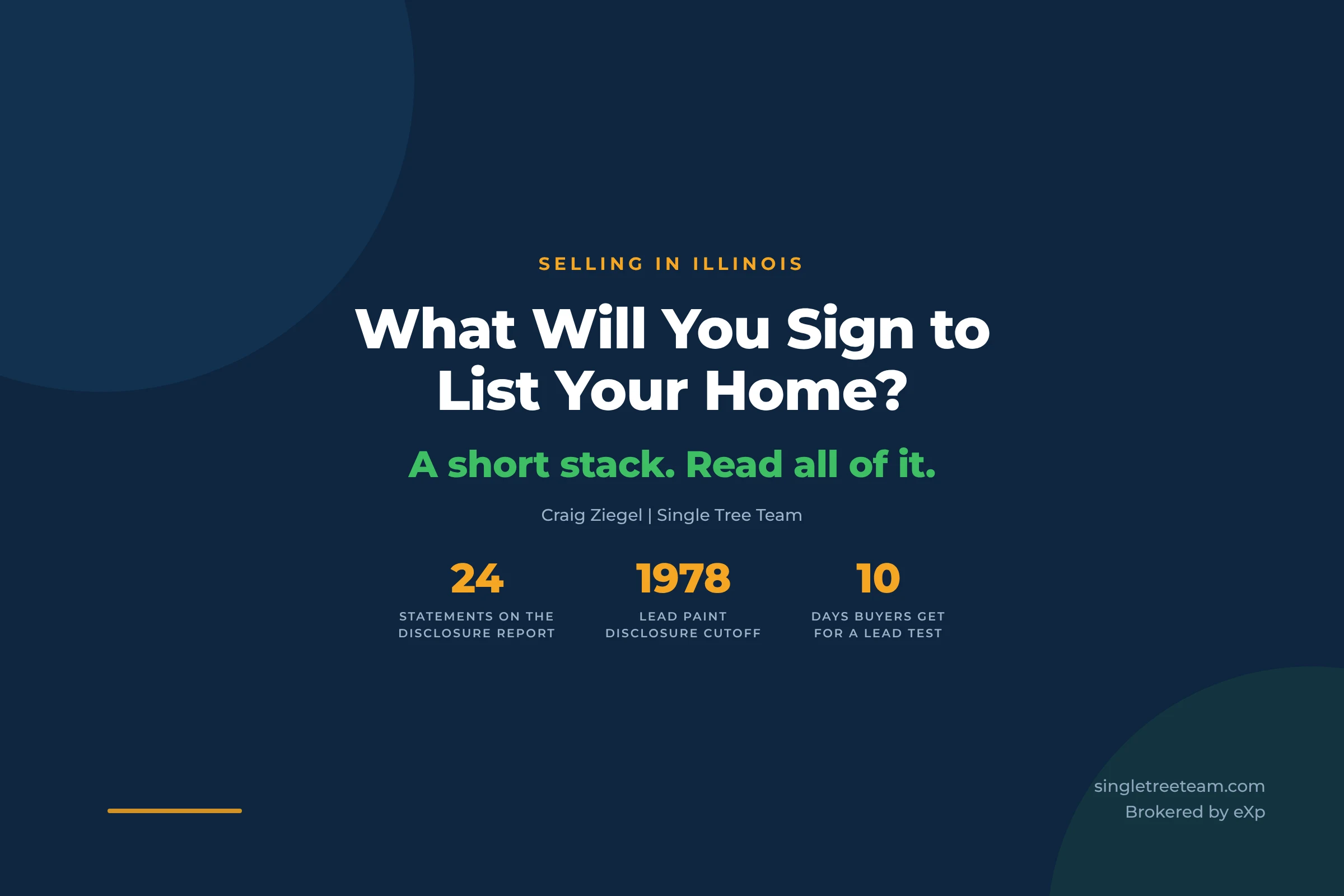
This is the form most sellers remember. The Residential Real Property Disclosure Act sets it out word for word, with 24 numbered statements covering things like basement leakage, roof leaks, the electrical and plumbing systems, radon, lead, termites, boundary disputes and uncorrected code violations. You mark each one yes, no or not applicable, and explain any yes.
- It is based on what you actually know. The form defines “aware” as actual notice or knowledge without any specific investigation. You do not have to go hunting for problems to fill it out.
- It has to reach the buyer before they sign a contract. If a material defect is disclosed only after both sides have signed, the buyer can generally terminate within 5 business days and get their earnest money back.
- It does not end at listing. If you learn before closing that something on the report was wrong or incomplete, you have to deliver a written supplement.
- Some sellers are exempt, such as certain transfers by court order, by an estate fiduciary, or between co-owners. Ask your attorney whether an exemption applies before relying on one.
The form itself, as written into the statute, says the seller may wish to consult an attorney before completing it. Sound advice.
4. The radon disclosure
Under the Illinois Radon Awareness Act, a seller of residential property has to give the buyer two things before the buyer is obligated under a contract: the Illinois Emergency Management Agency pamphlet on radon testing for real estate transactions, and a form called the Disclosure of Information on Radon Hazards.
On that form you initial the statements that apply, such as whether you know of elevated radon levels or have test records. If you have records showing elevated radon, you provide them. The Act says clearly that it does not require you to test or mitigate. It is a disclosure, not a repair order.
One detail worth knowing if you are selling a condo: the Act excludes dwelling units on the third story or higher above ground level.
5. Lead-based paint disclosure, for homes built before 1978
Plenty of homes in older parts of Belleville, Millstadt and Lebanon were built before 1978, and that triggers a federal rule. Sellers of pre-1978 housing must:
- Give buyers the EPA pamphlet “Protect Your Family From Lead in Your Home.”
- Disclose any known lead-based paint or lead hazards, and hand over any records or reports they have.
- Include the Lead Warning Statement with the contract.
- Give the buyer a 10-day opportunity to have a lead inspection or risk assessment, unless both sides agree in writing to change that.
- Keep a signed copy of the disclosure for three years after the sale.
Not sure when your house was built? Check before you list, not after an offer arrives.
6. MLS, marketing and lockbox authorization

The exact forms vary by brokerage and MLS, but expect to be asked about:
- MLS entry and the listing data, including permission to publish photos and your property details.
- Syndication of the listing to other websites.
- Lockbox and showing instructions: whether a lockbox goes on the door, who can use it, how much notice you want, and whether pets or cameras need mentioning.
These feel minor, but they decide who gets into your house and when. Set the rules you actually want.
7. Condo and HOA documents, if they apply
If you are selling a condominium, Section 22.1 of the Illinois Condominium Property Act requires you to obtain from the board and make available to a prospective buyer, on request, a set of association documents. That list includes the declaration, bylaws and rules, any unpaid assessments on your unit, anticipated capital expenditures, the reserve fund status, the latest financial statement, pending lawsuits and the association’s insurance coverage. The association has 10 business days to furnish them after a written request and may charge a fee.
Many other homeowners associations fall under the Common Interest Community Association Act, which has a similar resale list, though very small associations can be exempt. Either way, request the documents early. Waiting on a board is a very avoidable delay.
Have an attorney look before you sign
The Illinois State Bar Association’s guide for home sellers suggests sending the listing agreement to your attorney for review, and says an attorney can help complete the disclosure report and lead paint disclosure. That is cheap insurance on a contract that may run for months.
This post is a plain-English overview, not legal advice. Confirm anything that matters to your situation with a real estate attorney. If you want the bigger picture of the selling process, our home sellers guide for St. Clair County walks through it from start to finish.
Frequently asked questions
Does a listing agreement have to be in writing in Illinois?
Yes. The Illinois Real Estate License Act says all brokerage agreements shall be in writing, and an exclusive brokerage agreement must also spell out the minimum services the brokerage will provide, such as presenting offers and helping you negotiate until contingencies are satisfied or waived.
Do I have to agree to dual agency?
No. Illinois allows dual agency only with the informed written consent of all clients, and the required consent form states that you are not required to sign it unless you want to allow it. If you do consent, you will be asked to confirm it again in writing when an offer is signed.
When does the buyer have to get the disclosure report?
Before the buyer signs a contract. If a material defect is disclosed only after both sides have signed, the buyer can generally terminate within 5 business days of receiving the report and get their earnest money back. You also have to supplement the report in writing if you learn it was wrong before closing.
Do I have to test my house for radon before selling in Illinois?
No. The Illinois Radon Awareness Act requires you to give the buyer the state radon pamphlet and a radon disclosure form, and to share any records you have showing elevated radon. It specifically says it does not require the seller to test or mitigate.
Want to see the paperwork before you commit?
If you are thinking about selling, you are welcome to ask for blank copies of everything you would sign and read them at your own kitchen table, with your attorney if you like. A good place to start the conversation is knowing what the house is worth. You can get a free home value estimate here, or read how we think about pricing a house properly.
Craig Ziegel, Single Tree Team, eXp Realty. Serving Belleville, O’Fallon, Shiloh, Swansea, Mascoutah, Millstadt, Freeburg and the rest of St. Clair County.