
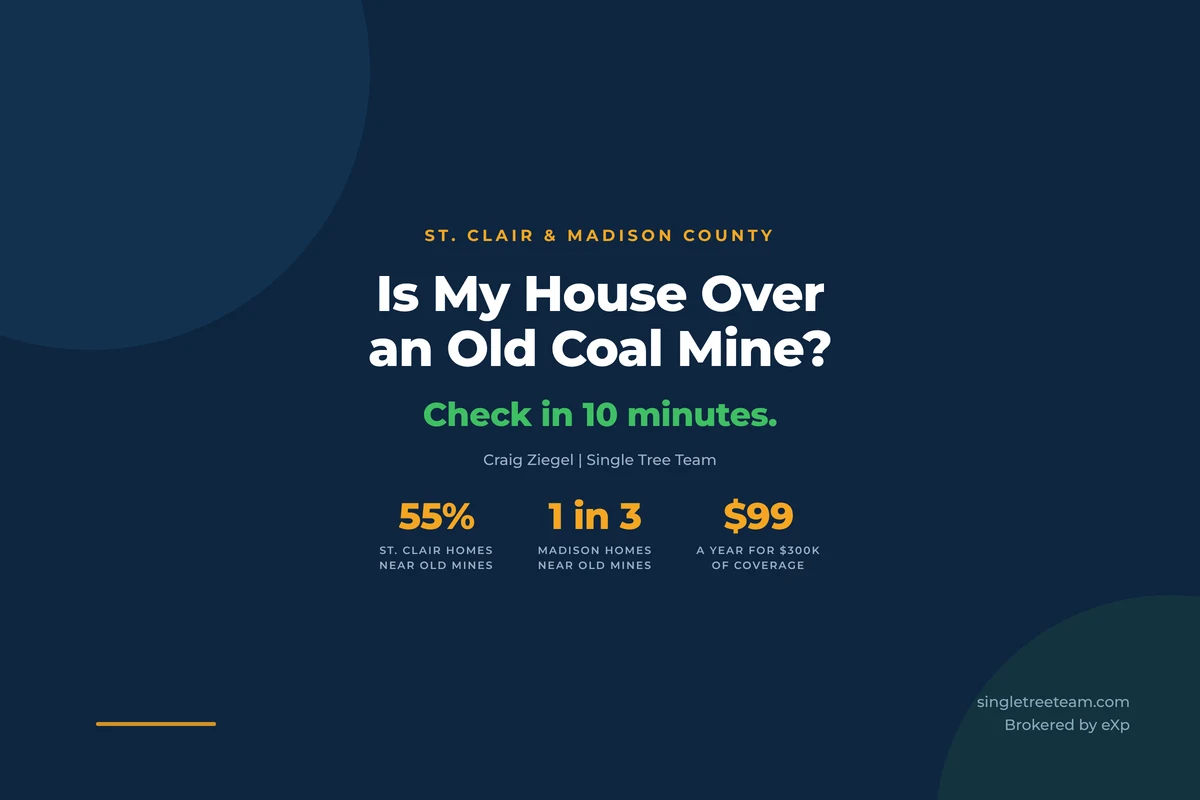
If you are buying a home in St. Clair or Madison County, there is a good chance it sits near an old coal mine. That sounds scarier than it usually is. Most of these homes never have a problem, and in these counties the insurance for it comes built into your homeowners policy. It is still worth ten minutes of homework before you close. Here is how I walk my buyers through it.
How common is this in the Metro East?
More common than people think. The Illinois State Geological Survey maps two zones around known underground mines. Zone 1 is the land over or right next to a mine. Zone 2 is the buffer around it, because old mine maps are not perfectly accurate. According to the Illinois Mine Subsidence Insurance Fund, here is how many homes fall inside those zones locally:
- St. Clair County: 62,456 of 114,272 housing units, a little more than half
- Madison County: 37,800 of 118,111 housing units, about one in three
- Clinton County: 5,632 of 15,492 housing units, a bit more than one in three
- Monroe County: 144 of 14,435 housing units, very few
Being in a zone does not mean the ground under a house will move. It means the house is close enough to old mine workings that it could be affected someday.
Step 1: Look up the address on the state mine map
The Illinois State Geological Survey has a free Coal Mine Viewer (ILMINES) that shows where the underground mines are. Find the address on the map and see what is nearby. The Survey is upfront that the maps come from old records and are not meant for a site-specific evaluation, so use it to decide whether to ask more questions, not as a final answer.
Step 2: Read the seller disclosure closely
The Illinois Residential Real Property Disclosure Report asks the seller whether they are aware of mine subsidence, settlement or other earth stability problems. Look at that answer and any explanation next to it. If you want the full picture of what Illinois sellers have to tell you, I wrote about it in Is Illinois a Buyer Beware State?
Then ask one more question in writing: has a mine subsidence claim ever been paid on this house, and were the repairs made? Per the Fund, if you buy a home with unrepaired subsidence damage that the seller was already paid for, the cost of fixing it becomes yours. Insurance companies can also refuse coverage on a property that has not been repaired.
Step 3: Have the inspector look for the signs
Every older house settles a little, so a crack is not proof of anything. What I ask inspectors to call out is a pattern: stair-step cracks in the foundation or brick, doors and windows that stick or will not latch, floors that slope, and walls pulling away from each other. If the inspector sees that, a structural engineer is the next call before you remove your inspection contingency.
Step 4: Confirm the coverage is on your policy
St. Clair, Madison, Clinton, Randolph and Washington counties are all among the 34 Illinois “mandatory” counties. In those counties, state law requires mine subsidence coverage to be included in homeowners policies automatically. The coverage amount is generally the same as your dwelling coverage for fire, up to the state limit of $750,000. Condo and co-op units are different: the limit there is $15,000 per unit. The only way you do not have it is if you reject it in writing.
It is also cheap. These are the Fund’s published residential examples, based on rates in effect since July 1, 2013:
| Mine subsidence coverage on the home | Annual premium |
|---|---|
| $100,000 | $44 |
| $200,000 | $71 |
| $300,000 | $99 |
| $400,000 | $127 |
| $500,000 | $154 |
| $750,000 | $224 |
So when your insurance agent sends the quote, ask them to confirm mine subsidence coverage is on it and has not been waived. If you are buying in Monroe County or another county that is not on the mandatory list, the coverage is optional. Your agent can add it, and if the map in Step 1 shows mines nearby, I would.
What if damage shows up after you move in?
Call your insurance agent or company first. Only insurance companies that contract with the Fund can report a claim and start the investigation. Subsidence is different from a storm: the ground can move slowly for years, so the policy in force on the date of loss responds, but the most it pays is the coverage amount you had when the damage first became noticeable. You can read more at imsif.com.
Frequently asked questions
How do I find out if a house in Illinois is over a coal mine?
Use the Illinois State Geological Survey’s free Coal Mine Viewer (ILMINES) to see whether there are old mines near the address, read the mine subsidence answer on the seller’s disclosure report, and ask the seller in writing whether a subsidence claim was ever paid. The state notes its mine maps are a starting point, not a site-specific evaluation.
Is mine subsidence insurance required in St. Clair County?
St. Clair County is one of 34 Illinois counties where mine subsidence coverage is automatically included in homeowners policies. The owner can reject it in writing, so confirm with your agent that it is on your policy.
How much does mine subsidence insurance cost in Illinois?
Per the Illinois Mine Subsidence Insurance Fund’s published examples, about $99 a year for $300,000 of coverage and $224 a year for $750,000.
Does Madison County require mine subsidence coverage?
Madison County is also one of the 34 mandatory counties, so the coverage is included in homeowners policies automatically. You can still reject it in writing, so confirm with your agent that it is on your policy.
Looking at a house and not sure?
Send me the address. I will pull it up on the mine map with you, go over the disclosure, and help you figure out whether it is worth a closer look before you commit. You can also read our St. Clair County real estate FAQ for the other questions buyers ask most.
Craig Ziegel, Single Tree Team, eXp Realty. Serving Belleville, O’Fallon, Shiloh, Swansea, Mascoutah, Millstadt, Freeburg and the rest of St. Clair County.